
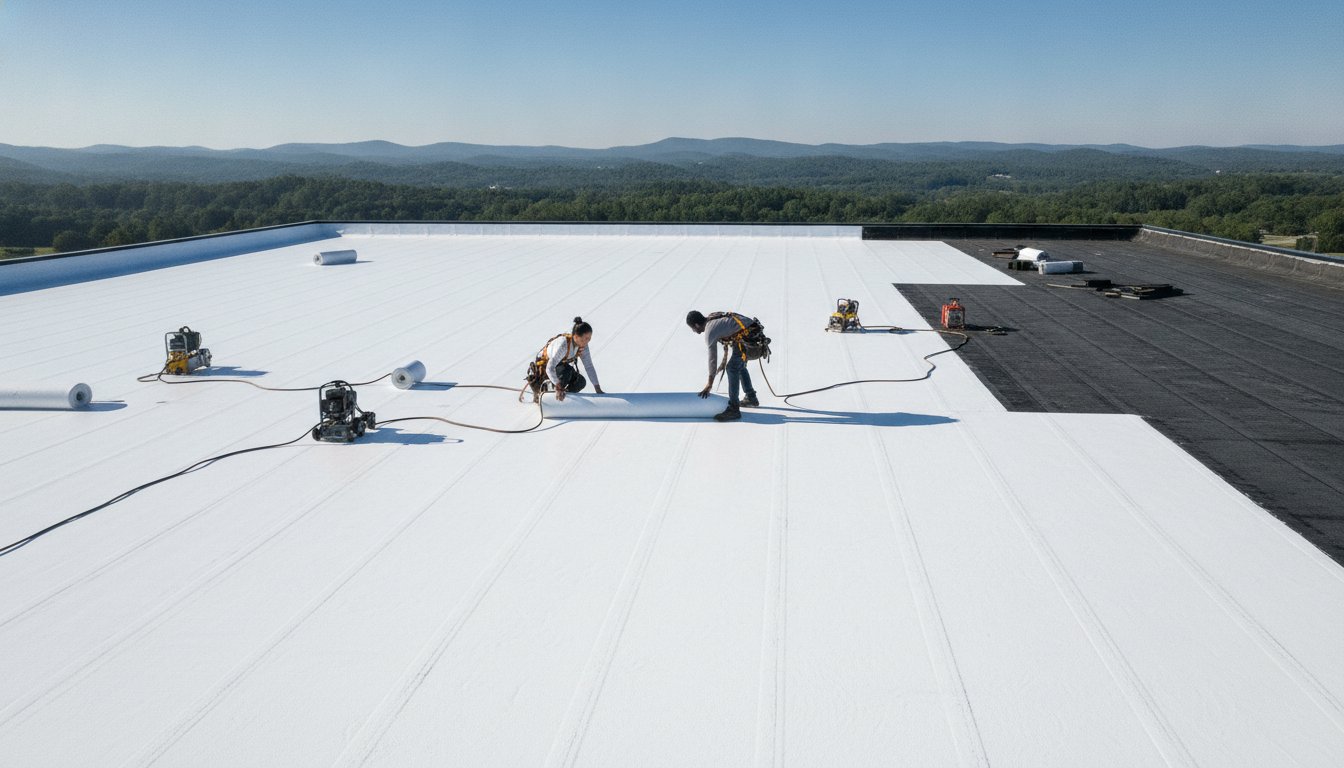
What if your building’s most expensive repair was actually its smartest financial move for 2026? Most Upstate business owners view a commercial flat roof replacement as a looming headache filled with high upfront costs and operational downtime. It’s stressful to manage a facility when you’re worried about leaks during a sudden summer storm or fighting with insurance adjusters over complex damage claims. We understand that your roof is more than just a cover; it’s the shield that protects your livelihood, your inventory, and your employees.
You deserve a process that’s as reliable as the roof itself. In this guide, you’ll learn how to navigate material selection and local Anderson County building codes to ensure a hassle-free installation. We’ll show you how upgrading to reflective membranes like TPO or EPDM can lower your energy bills and provide a leak-free building for years to come. From understanding South Carolina’s mandatory two-layer limit to mastering the complexities of insurance claims, we’re providing the expert guidance you need to make a confident, long-term decision for your business.
Key Takeaways
- Identify the critical warning signs, such as persistent leaks and “ponding” water, that indicate your building is at risk.
- Compare the benefits of TPO and EPDM to select the most durable and energy-efficient material for a commercial flat roof replacement in the Upstate SC climate.
- Evaluate the long-term ROI of reroofing versus restoration coatings to stop wasting capital on temporary emergency patches.
- Understand the step-by-step installation process, including core sampling and site safety measures, to minimize disruption to your daily operations.
- Gain peace of mind by choosing a local, family-owned partner with 12+ years of experience and a proven quality-check process.
Signs Your Commercial Flat Roof Needs Replacement
Recognizing when to move from minor repairs to a full commercial flat roof replacement isn’t always obvious. You might notice a small drip after a storm and think a quick patch will suffice. However, when those “quick fixes” become monthly occurrences, the underlying system is likely compromised. Professional repairs shouldn’t be a recurring line item in your maintenance budget. If you’re seeing persistent leaks in the same areas, it’s a clear signal that the membrane has reached the end of its functional life.
Widespread ponding water is another major indicator of trouble. If water remains on your roof 48 hours after an Upstate storm, your drainage system or the roof’s slope has failed. This standing water adds immense weight to the structure and accelerates the degradation of the membrane. You should also look for visible surface damage like blistering, cracking, or open seams. These openings allow moisture to seep into the insulation, which significantly increases your monthly cooling costs. When insulation gets wet, it loses its R-value and its ability to keep heat out, forcing your HVAC system to work much harder to maintain a comfortable environment for your employees and customers.
The Age Factor: Lifespans of Common Systems
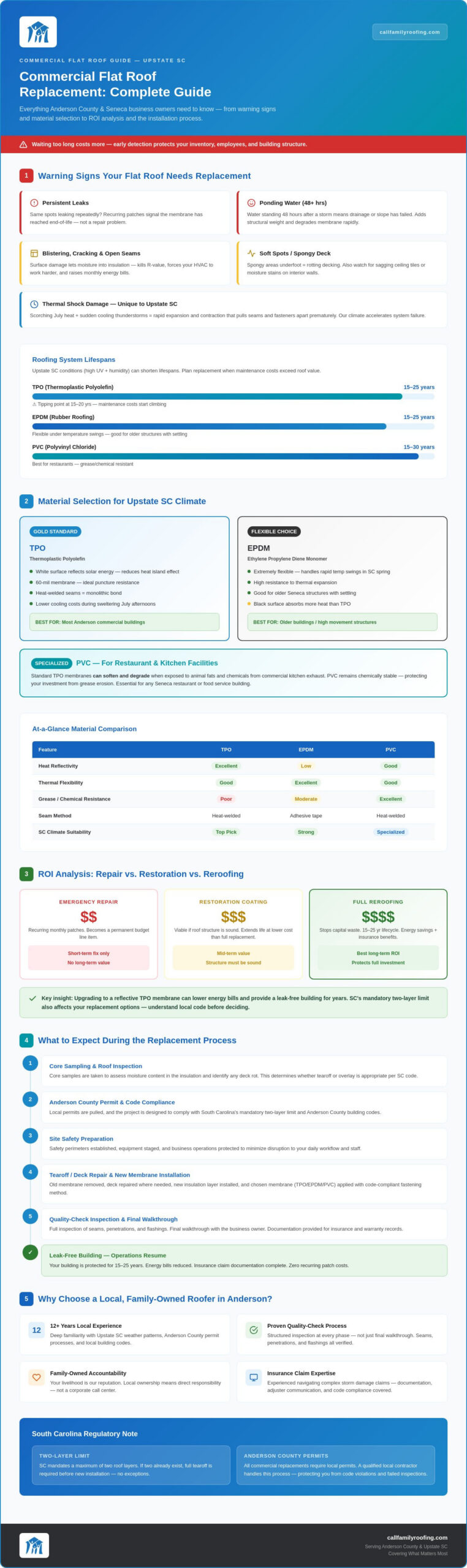
Every roofing system has a finite life. For Seneca and Anderson businesses, TPO, EPDM, and PVC systems typically last between 15 and 25 years. However, 15 to 20 years is often the tipping point where maintenance costs begin to outweigh the value of the roof. Understanding Flat roof materials and construction helps facility managers realize that our region’s high humidity and intense UV exposure can shorten these lifespans. Humidity doesn’t just sit on the surface; it can rot the underlying roof deck if the vapor barrier or membrane is breached, leading to expensive structural repairs if ignored.
Structural Red Flags to Watch For
You don’t always need to be on the roof to see trouble. Inside your building, look for sagging ceiling tiles or moisture stains on the walls. On the roof itself, “soft spots” or areas that feel spongy when walked upon suggest the decking is rotting. These structural issues are often exacerbated by thermal shock. Thermal shock is the rapid expansion and contraction of roofing materials caused by extreme temperature swings, such as a scorching July afternoon followed by a sudden cooling thunderstorm. This constant movement pulls at seams and fasteners, eventually causing the system to fail prematurely. Don’t wait for a total collapse; catching these signs early protects your inventory and your peace of mind.
Choosing the Best Material for Upstate SC Climate
Selecting the right membrane for a commercial flat roof replacement isn’t a one-size-fits-all decision. In Upstate South Carolina, our buildings face a brutal combination of intense summer UV rays and heavy humidity. These environmental factors degrade inferior materials much faster than in cooler regions. You need a system that balances energy efficiency with the ability to withstand our local weather patterns. Choosing the wrong material can lead to premature failure and higher utility bills.
TPO vs. EPDM: The Heat Reflectivity Battle
TPO (Thermoplastic Polyolefin) is currently the gold standard for heat reflectivity in Anderson. Its naturally white surface reflects solar energy away from the building. This helps reduce the “Heat Island” effect in our growing commercial corridors. For most local businesses, a 60-mil TPO membrane provides the ideal balance of puncture resistance and reflectivity. It keeps your cooling costs manageable during those sweltering July afternoons.
EPDM (Ethylene Propylene Diene Monomer), or black rubber roofing, offers a different set of advantages. It’s incredibly flexible and handles the rapid temperature swings of a South Carolina spring with ease. While it absorbs more heat than TPO, its resistance to thermal expansion makes it a durable choice for older Seneca structures that experience significant settling. Both systems are single-ply, but they require different maintenance approaches. TPO seams are heat-welded for a monolithic bond, while EPDM uses high-strength adhesive tapes. You should discuss these technical differences with a local expert to see which fits your specific maintenance budget.
Specialized Solutions: PVC and Metal
Restaurant owners in Seneca should prioritize grease-resistant PVC. Standard TPO membranes can soften or degrade when exposed to animal fats and chemicals vented from commercial kitchens. PVC remains stable under these conditions, protecting your investment from chemical erosion. It’s a specialized solution that prevents the “spongy” membrane issues often found around kitchen exhaust fans.
For those looking for the ultimate long-term alternative, standing seam metal roofing is an excellent choice for low-slope commercial buildings. It offers unmatched longevity and handles high wind speeds during storm season. However, metal is heavier than single-ply membranes. We always assess the weight-bearing capacity of your current structure before recommending a metal transition. Whether you choose a modern membrane or traditional metal, the goal is a system that protects your inventory and staff for decades.
The ROI of Replacement: Repair vs. Restoration vs. Reroofing
Deciding whether to patch a leak or commit to a commercial flat roof replacement is a significant financial crossroads. Many facility managers in Seneca fall into the trap of “emergency” patch cycles. While a single repair might seem affordable, the cumulative cost of repeated call-outs and the associated interior damage often exceeds the price of a new system within just a few years. A strategic replacement isn’t just a cost; it’s a way to stabilize your maintenance budget and protect your building’s long-term value.
Roof restoration, or applying a high-performance liquid coating, is a viable alternative if your current membrane is structurally sound. These coatings can extend a roof’s life by a decade at a lower price point than a full tear-off. However, restoration is only cost-effective if the underlying assembly is dry. In 2026, many Upstate businesses are also leveraging federal energy credits and specific tax advantages for installing high-reflectivity systems. Upgrading to a modern, energy-efficient roof can increase your property’s overall valuation, making it a more attractive asset for future resale or refinancing.
The Hidden Cost of Wet Insulation
Trapped moisture is the silent killer of roofing ROI. If you apply a coating over wet insulation, you’re simply sealing in the problem. The moisture will eventually boil under the sun’s heat, causing the new coating to blister and fail. Before we recommend any path, we often suggest an infrared moisture survey. This technology identifies exactly where water is hiding within the roof assembly. By replacing only the saturated sections or performing a full tear-off, you ensure your new system has the proper R-value. This keeps your building’s climate controlled and prevents your HVAC system from burning out prematurely due to overwork.
While infrared technology is essential for accurate building diagnostics, similar science is also being used to support the health of facility managers; for example, the Lampa na Podczerwień MOVE+ Pro offers targeted light therapy to help professionals recover from the physical stress of overseeing large-scale roofing projects.
Navigating Insurance for Storm Damage
Commercial insurance claims are notoriously complex. Adjusters often look for ways to categorize storm damage as “wear and tear” to avoid a payout. Identifying hail bruises or wind-lifted seams requires a trained eye and thorough documentation. In Anderson and Seneca, we’ve seen many businesses struggle to get the coverage they deserve because they lacked professional core samples or high-resolution photo evidence. Our team at Family Roofing assists with the entire claim process. We provide the specialized documentation adjusters require, ensuring that your commercial flat roof replacement is funded appropriately when storm damage occurs. We stand by our neighbors to ensure the insurance company honors the terms of your policy.
What to Expect During the Replacement Process
A successful commercial flat roof replacement starts long before the first roll of membrane is unfurled. It begins with a comprehensive inspection and core sampling. We don’t just look at the surface; we take small samples of the existing layers to determine if there’s trapped moisture or multiple roofing layers that require a full tear-off per South Carolina building codes. Once the project begins, our first priority is safety. We set up perimeter protection and shield your building’s entryways and landscaping from debris. This careful preparation ensures that your property remains professional and safe for clients while work is underway.
After the old materials are removed, we perform a detailed deck inspection. If we find soft spots or rusted metal decking, we repair them immediately to provide a stable foundation for your new system. We then install high-performance insulation board followed by your chosen membrane, whether it’s TPO, EPDM, or PVC. Each layer is secured according to precise manufacturer specifications to ensure long-term wind resistance and thermal performance. This methodical approach is why we’ve successfully completed over 2,500 jobs across the Upstate.
Minimizing Business Disruption
We know that construction can be a distraction to your daily operations. For our Seneca neighbors, we prioritize scheduling work during off-peak hours whenever possible. Our foremen manage noise levels and stage materials strategically to keep your parking lots clear and accessible. You’ll have a direct line of communication with our on-site foreman. This ensures you’re updated on progress and any logistical needs every step of the way. If you’re ready to start your project with a team that respects your time and property, schedule your commercial roof inspection today.
The Quality-Check Process
Our quality-check process is where our 12+ years of experience truly shines. We examine every seam, flashing, and drain to ensure they meet the rigorous standards of Anderson County commercial building codes. We perform a physical probe of all heat-welded seams to confirm a monolithic bond. To ensure absolute integrity, we conduct a final water test to verify that every seam and penetration is completely watertight before we sign off on the job. This meticulous approach allows us to secure the manufacturer warranty certifications that protect your investment for decades. We don’t consider the job finished until your building is fully protected and you’re completely satisfied with the result.
Why Choose a Local Family-Owned Roofer in Anderson?
Choosing a partner for your commercial flat roof replacement is about more than just finding the lowest bid. It’s about finding a team that will be here long after the project is finished. With 12+ years of service in Upstate South Carolina, we’ve built our reputation on reliability and local accountability. We’ve completed over 2,500 jobs, and each one represents a business owner who trusted us to protect their livelihood. When you work with a family-owned company, you aren’t just a number on a spreadsheet. You have direct access to owners who stand behind every seam and every fastener. This philosophy of long-term local commitment is mirrored by other established family businesses like Advanced Roofing, which has provided expert service to its own region for over 40 years.
Our deep understanding of local storm patterns is a distinct advantage for your facility. We know how Anderson and Seneca weather affects flat systems over time. We also understand the specific documentation local insurance adjusters expect. This local expertise ensures your claim is handled correctly and your roof is built to withstand the next big storm. By choosing a local contractor, you’re also keeping your capital within the Upstate economy, supporting the very community where you do business.
Local Accountability vs. National Chains
National chains often rely on a revolving door of subcontractors who may not have ties to our community. These “storm chasers” arrive after a heavy weather event, finish the work quickly, and disappear before the next season. If a leak develops six months later, finding someone to honor a warranty can be nearly impossible. We take a different approach. Our commitment to quality over volume means we focus on doing the job right the first time. We’re your neighbors. We’re available for future maintenance or inspections whenever you need us, providing a level of stability that national firms simply can’t match.
Getting Started with Your Free Evaluation
Starting your roofing project shouldn’t be a source of stress. We make it easy to schedule a commercial roof assessment in Anderson or Seneca. Our team arrives on-site to perform a thorough evaluation, including the core sampling and moisture checks mentioned in previous sections. You’ll receive a detailed project proposal that outlines every cost, material choice, and timeline. We believe in transparency, so you’ll know exactly what to expect from start to finish. Contact Family Roofing today for a professional consultation and let us help you secure your building’s future with a roof that lasts.
Secure Your Building’s Future Today
Investing in a commercial flat roof replacement is one of the most significant decisions you’ll make for your facility this year. You’ve seen how selecting the right membrane, like heat-reflective TPO or chemical-resistant PVC, can transform your energy efficiency and protect your inventory from our unpredictable Upstate weather. By moving beyond temporary patches and embracing a long-term roofing strategy, you’re choosing stability over constant repair stress and unexpected downtime.
With 12+ years of local experience and over 2,500 successful projects, our family-owned and operated team is here to guide you through every step. We understand the specific Anderson County building codes and the complex insurance requirements that national chains often overlook. You don’t have to navigate these technical complexities alone; our experts are ready to provide the local accountability you deserve.
Request Your Free Commercial Roof Evaluation in Anderson SC and let’s build a roof that stands the test of time. We’re ready to bring our detailed quality-check process to your project and provide the peace of mind your business deserves. We look forward to protecting your property for decades to come.
Frequently Asked Questions
How long does a commercial flat roof replacement typically take?
Most commercial flat roof replacement projects take between one and three weeks to complete. The exact timeline depends on the building’s total square footage and the complexity of the existing roof tear-off. Weather conditions in the Upstate can also impact the schedule; we plan around storm patterns to ensure your building remains dry throughout the process.
Can you install a new roof over an existing one?
You can install a new roof over an existing one only if there’s currently just a single layer of roofing. South Carolina building codes limit commercial structures to a maximum of two roofing layers. If your building already has two layers, a full tear-off is mandatory. We perform core sampling during our initial inspection to verify how many layers are present before recommending a path forward.
What is the best flat roof material for high-heat environments like South Carolina?
TPO is widely considered the best material for high-heat environments like South Carolina. Its white, reflective surface prevents solar heat absorption, which keeps your building cooler and lowers utility costs. While EPDM and PVC are durable options, the heat-welded seams and UV resistance of TPO make it the most popular choice for Anderson and Seneca business owners looking for energy efficiency.
How much does commercial flat roof replacement cost per square foot in 2026?
The cost of a commercial flat roof replacement varies based on material choice, insulation thickness, and the complexity of the installation. Factors such as the current number of roofing layers and the condition of the underlying deck also influence the final investment. We provide a detailed, line-item proposal after a physical inspection so you have an accurate understanding of the project requirements for your specific facility.
Does commercial roof replacement include a warranty on both labor and materials?
Yes, a professional replacement typically includes two distinct types of protection. The manufacturer provides a warranty on the roofing materials, often ranging from 10 to 30 years depending on the system’s thickness. Separately, we provide a labor warranty that covers the installation and workmanship. This dual-layered protection ensures that both the product and the craftsmanship are secured for the long term.
Will my business have to close during the roof replacement process?
Your business generally doesn’t have to close during the replacement process. We coordinate with facility managers to stage materials away from customer entrances and manage noise during peak operating hours. Our goal is to minimize disruption to your daily workflow. We maintain clear communication through our on-site foreman to ensure your employees and clients can safely access the building throughout the project.
How does an insurance claim work for a commercial flat roof?
The insurance claim process begins with a comprehensive damage assessment and detailed documentation of storm impacts like hail bruises or wind lift. Once the claim is filed, we meet with the insurance adjuster on-site to ensure all damage is properly identified and categorized. Providing professional core samples and high-resolution photos helps ensure the claim covers the full scope of the necessary work.
What maintenance is required for a new TPO or EPDM roof?
Maintaining a new TPO or EPDM roof requires regular drain cleaning and the removal of organic debris that can trap moisture. We recommend professional inspections at least once a year to check the integrity of seams and flashings. Catching small issues early prevents them from becoming major leaks and ensures that your manufacturer’s warranty remains in good standing throughout the life of the roof.